
Feeding a dog sounds simple until you realize that the amount written on a food bag does not always work perfectly for your individual pet.
I have seen owners follow a feeding chart carefully and still notice their dog gaining weight. Others assume their dog needs more food because the bowl is always empty, only to discover that the dog simply loves eating.
On the other side, some dogs lose weight even though their owners believe they are feeding enough.
The truth is that feeding recommendations are starting points, not guarantees.
Your dog’s ideal food intake can depend on age, activity level, body size, metabolism, treats, health status, and the calorie density of the food.
Learning the difference between overfeeding and underfeeding can help you notice problems earlier and make better decisions about your dog’s nutrition.
What Is Overfeeding?
Overfeeding happens when a dog regularly consumes more calories than it needs.
This does not always mean giving huge meals.
Even small amounts of extra food can add up over time.
For example, imagine adding only a few extra treats every day.
Those calories may seem insignificant.
Over several months, however, they can contribute to gradual weight gain.
Common sources of accidental overfeeding include:
- Large meal portions
- Frequent treats
- Table scraps
- High-calorie chews
- Multiple family members feeding the dog
- Guessing portions instead of measuring
Signs You May Be Overfeeding Your Dog
1. Gradual Weight Gain
Gradual weight gain is one of the clearest warning signs.
A dog does not usually become overweight overnight.
The change often happens slowly.
That is why regular weight checks are helpful.
You can track your dog’s weight using:
- A home scale for small dogs
- A veterinary clinic scale
- A pet scale
- A simple Google Sheets or notes app record
2. Loss of a Visible Waist
Look at your dog from above.
Many dogs at a healthy body condition have a noticeable waist behind the ribs.
If the body becomes increasingly round or straight, excess body fat may be developing.
Breed and body shape can vary, so this should not be used as the only measurement.
3. Difficulty Feeling the Ribs
You should generally be able to feel your dog’s ribs with gentle pressure.
If you need to press through a thick layer of fat, the dog may be carrying excess weight.
Do not confuse visible ribs with easily felt ribs.
The ideal body condition can vary between individual dogs.
4. Lower Energy or Reduced Stamina
Extra body weight can make movement more difficult.
You may notice that your dog:
- Tires more easily
- Avoids longer walks
- Has less interest in play
- Moves more slowly
However, low energy can also have medical causes.
Do not assume that tiredness is caused only by weight.
5. Clothes or Harnesses Become Tighter
Some owners notice weight changes through equipment before seeing changes in the mirror.
A harness that once fit comfortably may become tight around the chest or abdomen.
This can be a useful reason to check your dog’s weight.
What Is Underfeeding?
Underfeeding happens when a dog consistently receives fewer calories or nutrients than it needs.
This can occur because of:
- Portions that are too small
- Highly active lifestyles
- Poor appetite
- Incorrect food choice
- Difficulty absorbing nutrients
- Underlying health conditions
It is important to remember that unexplained weight loss should not automatically be treated by simply adding more food.
Health problems can also cause weight loss.
Signs You May Be Underfeeding Your Dog
1. Unexpected Weight Loss
Weight loss is one of the most noticeable signs.
If your dog’s food amount has not changed but weight continues to decrease, investigate the reason.
A qualified veterinarian can help determine whether the issue is related to food intake or another health concern.
2. Very Prominent Bones
Some dogs naturally have lean body shapes.
However, unusually visible:
- Ribs
- Spine
- Hip bones
may indicate that the dog is underweight.
Long-haired dogs can make visual assessment more difficult.
3. Loss of Muscle
Weight loss does not always mean loss of fat.
Dogs can also lose muscle.
You may notice reduced muscle around areas such as:
- Hind legs
- Shoulders
- Back
Muscle loss should be discussed with a veterinarian.
4. Low Energy
Dogs receiving insufficient calories may sometimes appear tired or less interested in activity.
However, fatigue can have many causes.
If your dog’s energy changes suddenly, especially with other symptoms, contact a veterinarian.
5. Persistent Hunger
Some dogs may act hungry when they need more food.
However, appetite alone is not a reliable indicator.
Many healthy dogs will continue eating even after meeting their calorie needs.
Persistent hunger should be considered alongside:
- Weight
- Body condition
- Activity level
- Health
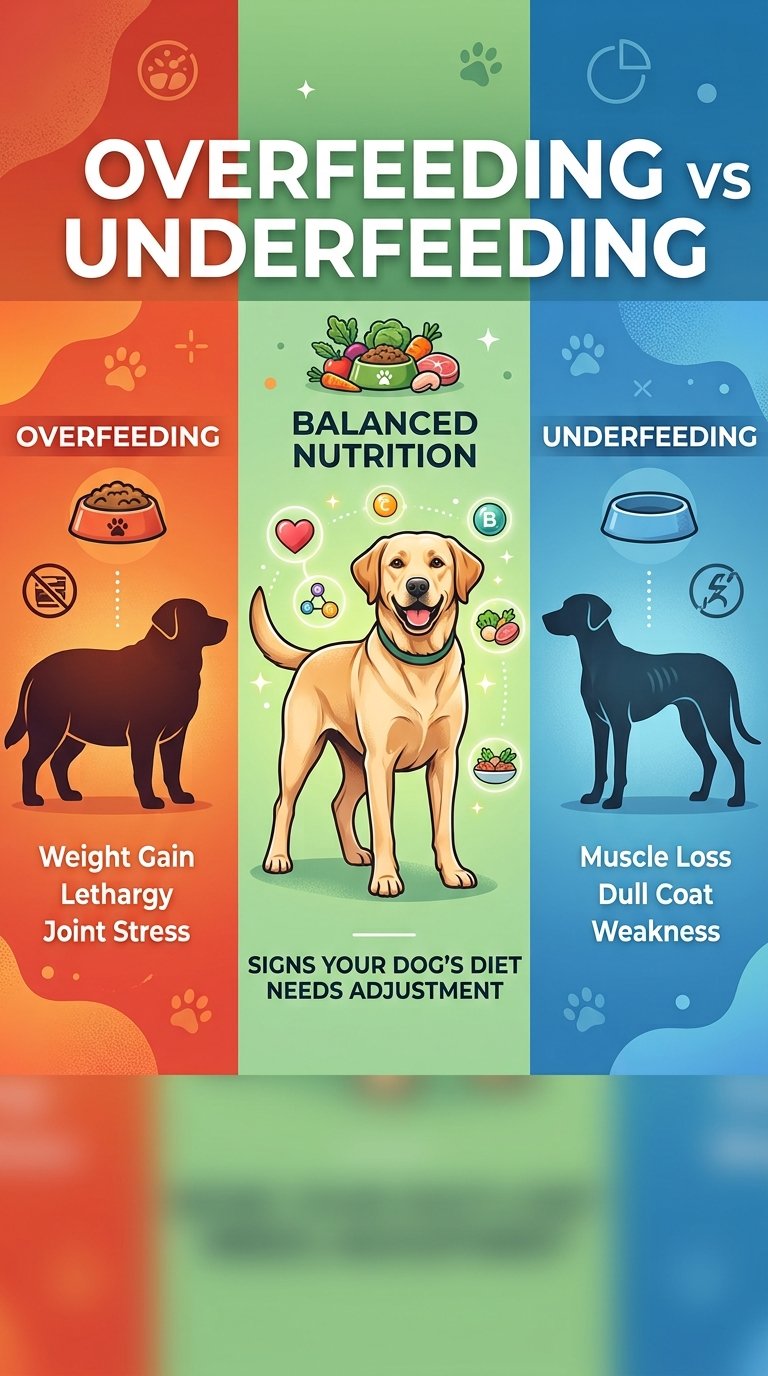
Overfeeding vs Underfeeding: Quick Comparison
| Sign | Possible Overfeeding | Possible Underfeeding |
|---|---|---|
| Weight | Gradual gain | Unexplained loss |
| Body shape | Rounder body | Very thin appearance |
| Ribs | Difficult to feel | May be highly visible |
| Waist | Less visible | May appear overly narrow |
| Energy | May decrease due to excess weight | May decrease due to insufficient energy |
| Muscle | May be hidden by fat | Possible muscle loss |
These signs are general indicators, not medical diagnoses.
Why Food Labels Are Only Starting Points
Dog food labels usually provide recommended feeding amounts based on weight.
This is useful, but the recommendation cannot perfectly predict your individual dog’s needs.
For example, two 25-kilogram dogs may have very different lifestyles.
Dog A
- Short daily walks
- Mostly indoors
- Low activity
Dog B
- Long walks
- Regular running
- Training activities
Dog B may use more energy.
Giving both dogs the same amount of food may not produce the same results.
The Hidden Problem: Treat Calories
One of the easiest ways to accidentally overfeed a dog is through treats.
Consider a normal day.
Morning
One training treat.
Afternoon
A dental chew.
Evening
A few bites of human food.
Before Bed
Another treat.
Each item may seem small.
Together, they can add a significant number of calories.
A practical solution is to track treats.
You can use:
- Apple Notes
- Google Keep
- Google Sheets
- A family feeding chart
- Pet tracking apps
If several people feed your dog, a shared checklist can prevent accidental double-feeding.
How to Check Your Dog’s Body Condition
A scale is useful, but weight alone does not show everything.
Two dogs can weigh the same but have different body compositions.
A basic body condition check involves looking at:
From Above
Does your dog have a visible waist?
From the Side
Is there a reasonable abdominal tuck?
By Touch
Can you generally feel the ribs without excessive pressure?
For a more accurate assessment, ask your veterinarian to perform a body condition evaluation.
How to Adjust Your Dog’s Food Safely
If you believe your dog may be receiving too much or too little food, avoid making dramatic changes without understanding the cause.
Use a gradual approach.
Step 1: Measure Everything
For one week, record:
- Main meals
- Treats
- Chews
- Table food
- Supplements containing calories
A digital kitchen scale can be more accurate than guessing.
Step 2: Check the Food’s Calories
Look at the packaging.
Find:
- Calories per cup
- Calories per kilogram
- Recommended feeding guidelines
Different brands can have very different calorie densities.
Step 3: Monitor Activity
Has your dog’s lifestyle changed?
For example:
- Less exercise
- More exercise
- Seasonal changes
- Recovery from illness
- Aging
These changes may affect calorie requirements.
Step 4: Monitor Weight Over Time
Do not judge progress after one day.
Regular weekly or monthly checks can provide more useful information.
You can track results with:
- A spreadsheet
- A smartphone app
- A notebook
Step 5: Speak With a Veterinarian When Needed
If weight changes are unexpected or significant, consult a qualified veterinarian.
This is particularly important when your dog has:
- Major appetite changes
- Vomiting
- Diarrhea
- Weakness
- Increased thirst
- Other unusual symptoms
A Realistic Feeding Example
Imagine a medium-sized dog receiving two cups of dry food every day.
The owner believes the portion is correct because it matches a recommendation from another dog owner.
However, after several months, the dog’s waist becomes less visible.
The owner also provides:
- Training treats
- Dental chews
- Table scraps
After tracking all food for one week, the owner realizes that the main meals are only part of the problem.
The extra calories are coming from snacks.
Instead of drastically cutting the dog’s meals, the owner can review the complete diet with a veterinarian and make appropriate adjustments.
This is why looking at the entire daily diet is more useful than focusing only on the food bowl.
Common Overfeeding Mistakes
Feeding Based on Begging
Dogs may beg even when they are not nutritionally hungry.
Avoid assuming that begging always means the dog needs another meal.
Using Large Scoops Instead of Measuring
A scoop is not always equal to a standard cup.
Use consistent measuring tools.
Forgetting Multiple Feeders
When several family members feed the dog, portions can accidentally be doubled.
A shared feeding schedule can help.
Common Underfeeding Mistakes
Using the Same Portion Forever
A dog’s nutritional needs can change with:
- Age
- Activity
- Weight
- Lifestyle
Review portions periodically.
Ignoring Weight Loss
Unexpected weight loss should not be ignored.
The cause may not simply be insufficient food.
Assuming Every Food Has the Same Calories
One cup of one dog food may contain significantly more calories than another.
Always check the label.
When Your Dog’s Diet Needs Adjustment
Consider reviewing your dog’s diet when you notice:
- Gradual weight gain
- Unexplained weight loss
- Major changes in activity
- Changes in body shape
- Changes in appetite
- A new life stage
- Significant changes in routine
A small adjustment made early may be easier than correcting a major weight change later.
Tools That Can Help With Portion Control
You do not need expensive equipment.
Useful tools include:
Digital Kitchen Scale
Helps measure food accurately.
Measuring Cup
Provides consistent portions.
Airtight Food Container
Makes food storage and daily measuring easier.
Smartphone Reminder
Helps prevent missed or duplicate meals.
Shared Family Checklist
Useful when several people care for the same dog.
Special Considerations for Puppies and Senior Dogs
Puppies
Puppies are growing and have different nutritional requirements from adult dogs.
They may need multiple meals and food designed for their life stage.
Senior Dogs
Senior dogs may experience changes in:
- Activity
- Muscle mass
- Appetite
- Health
Their nutritional needs should be reviewed regularly.
Unexpected weight loss in an older dog should be discussed with a veterinarian.
Final Thoughts
Overfeeding and underfeeding are not always obvious at first.
The most useful approach is to stop relying only on the food bowl and start looking at the bigger picture.
Measure meals consistently. Count treats and other sources of calories. Monitor your dog’s weight and body condition. Adjust your approach when activity or lifestyle changes.
Most importantly, avoid assuming that every weight change is simply a feeding problem. Sudden or unexplained changes in weight, appetite, energy, or digestion deserve professional attention.
A feeding chart can give you a starting point, but regular observation helps you determine whether that starting point is actually working for your individual dog.