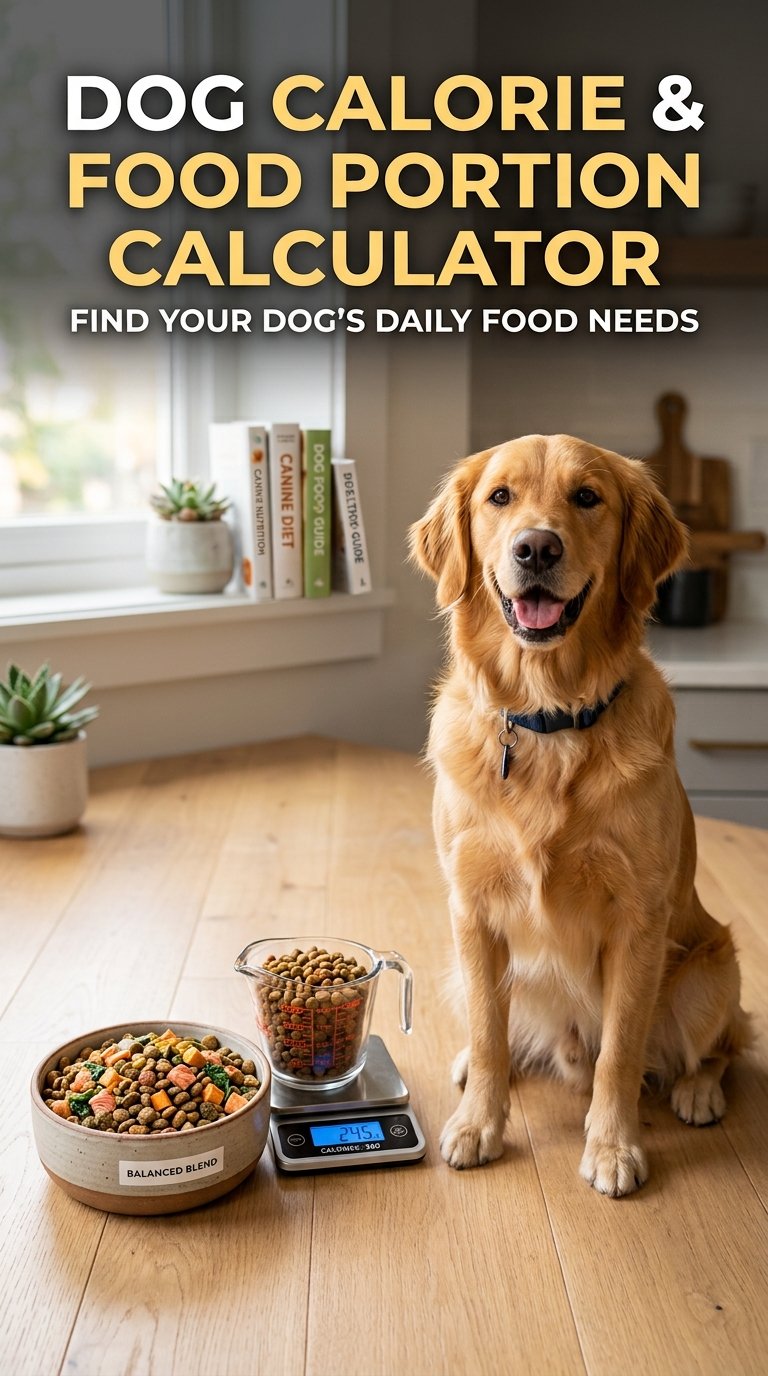

🐶 Dog Daily Calorie & Food Calculator
Figuring out how much food your dog needs every day can be confusing.
Many dog owners look at the feeding chart printed on a bag of kibble and assume that the recommended amount will be perfect for their dog. In reality, those charts are general guidelines. Your dog's actual food needs can vary depending on weight, age, activity level, lifestyle, body condition, and the calorie content of the food.
Our Dog Calorie & Daily Food Portion Calculator is designed to give you a useful starting estimate.
By entering information such as your dog's weight, age, and activity level, the calculator can estimate daily calorie requirements and help convert those calories into an approximate amount of kibble.
The result can be shown in practical measurements such as:
- Estimated daily calories
- Daily kibble amount in grams
- Daily kibble amount in cups
- Suggested meal portions
Remember that a calculator result is an estimate rather than a replacement for professional veterinary advice.
How to Use the Dog Calorie & Daily Food Portion Calculator
Using the calculator is simple.
Step 1: Enter Your Dog's Weight
Start by entering your dog's current weight.
Use the most recent and accurate weight possible.
You may be able to weigh a small dog at home by standing on a scale alone and then standing on the scale while holding your dog.
For larger dogs, a veterinary clinic or pet facility may have an appropriate scale.
Weight is one of the main factors used when estimating daily energy requirements.
Step 2: Select Your Dog's Age or Life Stage
Your dog's nutritional needs can change throughout life.
Common life stages include:
- Puppy
- Adult
- Senior
Puppies are still growing and may have different nutritional requirements from adult dogs.
Adult dogs may have more stable requirements, although activity level can create significant differences.
Senior dogs may experience changes in activity, muscle mass, appetite, or health that can affect their nutritional needs.
Step 3: Choose Your Dog's Activity Level
Be realistic when choosing an activity level.
A dog that takes a short walk and spends the rest of the day sleeping may have different energy requirements from a dog that regularly runs, hikes, trains, or performs working activities.
Common activity levels include:
Low Activity
Suitable for dogs that spend much of the day resting and receive limited exercise.
Moderate Activity
Suitable for many family dogs that receive regular walks and daily play.
High Activity
Suitable for dogs that regularly exercise for longer periods or participate in demanding activities.
Very Active
Suitable for highly active, athletic, sporting, or working dogs with significant daily energy expenditure.
Choosing the correct activity level can make the calculator's estimate more useful.
Step 4: Enter Your Dog Food's Calorie Information
This step is very important.
Different dog foods can contain very different numbers of calories.
You may find calorie information listed on the packaging as:
- kcal per cup
- kcal per 100 grams
- kcal per kilogram
- Calories per serving
The calculator uses this information to estimate how many grams or cups of food may provide the required daily calories.
For example, two different kibble products may look similar but contain significantly different amounts of energy per cup.
That means the same cup measurement may provide very different calorie amounts.
Step 5: Review Your Estimated Results
After entering the required information, the calculator may provide estimates such as:
- Daily calorie requirement
- Estimated kibble portion in grams
- Estimated kibble portion in cups
- Suggested meal division
For example, if the calculator estimates that your dog needs approximately 900 calories per day, and the kibble provides 400 calories per 100 grams, the estimated daily amount would be based on that calorie relationship.
The exact result depends on the information you enter and the calorie density of your dog's food.
Why Dog Calorie Needs Are Different for Every Dog
Two dogs can weigh the same amount but require different amounts of food.
Imagine two dogs that both weigh 25 kilograms.
The first dog:
- Takes short walks
- Spends most of the day indoors
- Has a relaxed lifestyle
The second dog:
- Runs regularly
- Goes hiking
- Participates in training
- Has a highly active routine
Although both dogs weigh the same, the second dog may use more energy.
This is why weight alone does not provide a complete feeding recommendation.
What Are Dog Calories?
Calories are a measure of energy.
Your dog uses energy throughout the day for normal body functions such as:
- Breathing
- Circulating blood
- Maintaining body temperature
- Digesting food
- Supporting organs
- Repairing tissues
- Walking and exercising
Even a sleeping dog uses energy.
Additional activity increases energy requirements.
A calorie calculator estimates how much energy your dog may need based on information such as body weight and activity level.
Why Food Portions Are Not Always Measured Accurately by Cups
Many dog owners use a cup to measure food.
While this can be convenient, one cup does not always contain the same number of calories.
Consider two different dog foods.
Food A
Approximately 350 calories per cup.
Food B
Approximately 500 calories per cup.
If your dog eats two cups of Food A, it receives approximately 700 calories.
Two cups of Food B would provide approximately 1,000 calories.
This difference can become important over time.
For more consistent portion control, some owners prefer using a digital kitchen scale to measure food in grams.
Understanding Daily Kibble Portions
The calculator can convert estimated calorie needs into practical food portions.
Depending on your dog's food information, the result may show:
- Grams per day
- Cups per day
For example, the calculator may estimate:
Daily food requirement: 300 grams
If your dog eats two meals per day, this could be divided into:
- Morning: 150 grams
- Evening: 150 grams
This is only an example.
The correct amount depends on your dog's individual calorie needs and the specific food you use.
How Often Should You Feed Your Dog?
Meal frequency depends on several factors, including age.
Puppies
Puppies may need more frequent meals because they are growing.
Adult Dogs
Many adult dogs are fed one or two meals each day.
Senior Dogs
Senior dogs may have different feeding routines depending on their health and veterinary recommendations.
A consistent feeding schedule can make it easier to monitor your dog's appetite and food intake.
Don't Forget About Treat Calories
One common feeding mistake is focusing only on the main meals.
Treats, chews, and table food can also contribute calories.
For example:
- Training treats
- Dental chews
- Snacks
- Table scraps
If several people in the household give treats, the total calorie intake can increase without anyone realizing it.
A simple notes app or shared feeding schedule can help track meals and treats.
How to Tell Whether Your Dog's Portion May Need Adjustment
A calculator provides a starting estimate.
Your dog's body condition provides important real-world feedback.
Consider reviewing your dog's diet if you notice:
- Gradual weight gain
- Unexplained weight loss
- Major changes in appetite
- Changes in activity
- Reduced energy
- Changes in body shape
A healthy dog generally has an appropriate body condition rather than simply matching a specific number on a feeding chart.
Your veterinarian can provide a more accurate body condition assessment.
Tips for Using Your Calculator Results
To get the most useful result:
Use an Accurate Weight
Do not guess your dog's weight if possible.
Check the Food Label Carefully
Enter the correct calorie information.
Choose the Correct Activity Level
Avoid selecting "very active" for a dog that only receives normal daily walks.
Measure Food Consistently
A digital kitchen scale can help measure kibble in grams.
Monitor Changes Over Time
Your dog's needs can change with:
- Age
- Activity
- Lifestyle
- Weight
- Health
Review portions periodically.
Common Mistakes When Using Dog Food Calculators
Treating the Result as an Exact Prescription
A calculator provides an estimate.
Individual needs can vary.
Forgetting Treats
Extra calories can affect weight management.
Entering Incorrect Food Calories
Always check the food package.
Ignoring Activity Changes
A dog's food requirements may change when its lifestyle changes.
Ignoring Unexpected Weight Changes
Sudden or unexplained weight changes should be discussed with a veterinarian.
When a Dog Calorie Calculator May Not Be Enough
General calculators may not be appropriate for every situation.
Additional veterinary guidance may be especially important for dogs with:
- Medical conditions
- Significant weight problems
- Food allergies
- Digestive problems
- Pregnancy
- Recovery from illness
- Major appetite changes
Puppies and highly active working dogs may also have more specialized nutritional requirements.
Frequently Asked Questions
How much should I feed my dog every day?
The answer depends on your dog's weight, age, activity level, body condition, and the calorie content of the food.
A calculator can provide a useful starting estimate, but feeding recommendations may need adjustment over time.
Is measuring dog food in grams better than cups?
Measuring food in grams with a digital kitchen scale can provide more consistent results because kibble density can vary between products.
Should I follow the feeding chart on the dog food bag?
The feeding chart can be a useful starting point. However, individual dogs may require different portions depending on their activity and body condition.
How often should I weigh my dog?
Regular weight checks can help you identify gradual changes. The appropriate frequency depends on your dog's age, health, and individual circumstances.
Can treats affect my dog's calorie intake?
Yes. Treats, chews, and table food can add calories and should be considered when reviewing your dog's total daily food intake.
Important Disclaimer
This Dog Calorie & Daily Food Portion Calculator provides general estimates for informational purposes only.
The results are not veterinary advice and should not be used as a diagnosis, treatment plan, or replacement for professional nutritional guidance.
Every dog is different.
Age, breed, body condition, health status, activity level, reproductive status, and medical conditions can affect nutritional requirements.
If your dog is experiencing unexplained weight changes, appetite changes, vomiting, diarrhea, weakness, or other concerning symptoms, contact a qualified veterinarian.
For dogs with medical conditions or specialized nutritional needs, speak with a veterinarian before making significant dietary changes.
Final Thoughts
A dog calorie calculator can make feeding decisions easier by turning general information into a practical estimate.
Instead of guessing how much food belongs in the bowl, you can use your dog's weight, age, activity level, and food calorie information to estimate a daily starting portion.
The most important thing is to treat the result as a guide rather than a permanent rule.
Measure food consistently, monitor your dog's weight and body condition, include treats in the overall diet, and adjust your approach when your dog's lifestyle changes.
Your dog's nutrition needs may change over time, and paying attention to those changes can help you build a more practical and responsible feeding routine.