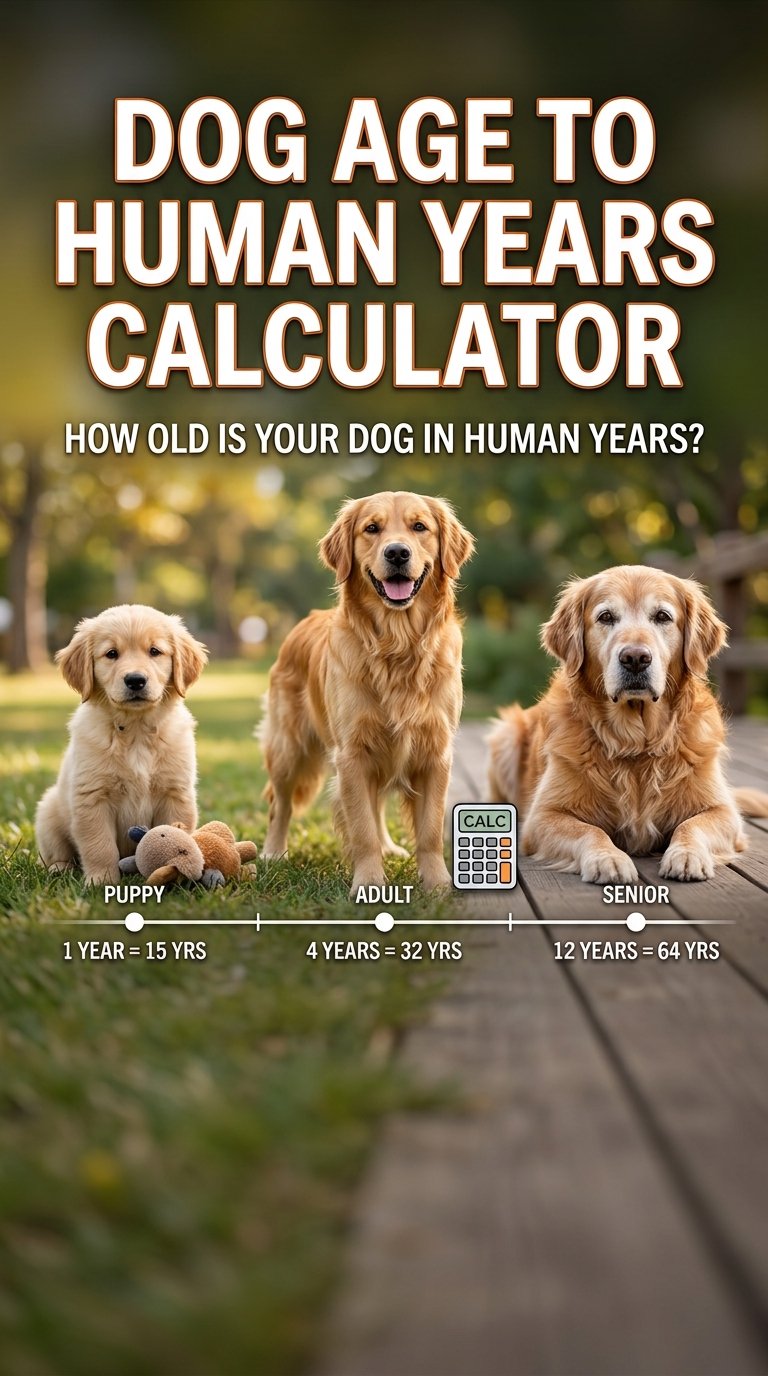

🐕 Dog Age to Human Years Calculator
Many people have heard the old rule that one dog year equals seven human years.
It is easy to remember, but it is not an accurate way to understand how dogs age.
Dogs mature quickly during their early years. After that, the aging process can vary depending on factors such as breed size, genetics, health, and lifestyle.
This is why a small dog and a large dog of the same age may not always have the same equivalent age in human years.
Our Dog Age to Human Years Calculator helps provide a more useful estimate by considering your dog's age and size category.
You can choose between:
- Small breeds
- Medium breeds
- Large breeds
The calculator then provides an estimated comparison between your dog's age and a human age.
It is important to remember that the result is an estimate. Dogs do not age in exactly the same way as humans, so no calculator can provide a perfectly exact comparison.
How to Use the Dog Age to Human Years Calculator
Using the calculator is simple.
Step 1: Enter Your Dog's Age
Enter your dog's current age in years.
If your dog is less than one year old, your calculator may allow you to enter months.
For example:
- 6 months
- 1 year
- 3 years
- 7 years
- 12 years
Accurate age information helps produce a more useful estimate.
Step 2: Select Your Dog's Size
Choose the size category that best matches your dog.
Small Breed
Small dogs generally have a lower adult body weight.
Examples may include:
- Chihuahua
- Yorkshire Terrier
- Pomeranian
- Maltese
- Toy Poodle
Medium Breed
Medium-sized dogs fall between small and large breeds.
Examples may include:
- Beagle
- Border Collie
- Cocker Spaniel
- Australian Shepherd
Large Breed
Large dogs generally have higher adult body weights and may age differently from smaller breeds.
Examples may include:
- German Shepherd
- Labrador Retriever
- Golden Retriever
- Rottweiler
- Great Dane
Breed categories can vary, especially for mixed-breed dogs.
Step 3: View Your Estimated Human Age
The calculator will estimate how old your dog may be in human years.
For example, a young dog matures much faster during the first few years of life than the traditional “multiply by seven” rule suggests.
As dogs become older, breed size can become more important when estimating the human-age comparison.
Why the “Multiply by Seven” Rule Is Not Accurate
The idea that one dog year equals seven human years is simple.
However, it does not reflect how dogs actually develop.
Consider a one-year-old dog.
At one year old, many dogs have already reached sexual maturity and are approaching adulthood.
A seven-year-old human child is obviously at a very different stage of development.
This shows why multiplying every dog year by seven creates an oversimplified result.
Dogs develop rapidly during the first years of life.
After reaching adulthood, the aging rate changes.
How Dogs Age During Their First Years
The first years of a dog's life are especially important.
A puppy goes through several major developmental stages.
These may include:
- Early growth
- Social development
- Physical development
- Sexual maturity
- Adult maturity
A dog's first year therefore represents much more development than simply seven human years.
The second year also represents an important transition toward full adulthood.
After this period, aging tends to progress differently depending on the individual dog.
Why Breed Size Matters
One of the most interesting things about dogs is that size can influence lifespan and aging patterns.
Generally, smaller dogs often live longer than larger breeds.
Large and giant breeds may reach senior stages earlier than small breeds.
For example, a small dog and a giant dog may both be eight years old.
However, their health and life stages may be different.
The smaller dog may still be considered mature but active.
A giant breed dog may already be entering its senior years.
This is why our calculator separates dogs into different size categories.
Small Dog Age in Human Years
Small breed dogs often have longer average lifespans than larger breeds.
Examples include:
- Chihuahua
- Dachshund
- Pomeranian
- Shih Tzu
- Toy Poodle
Many small dogs remain active well into later years.
However, every dog is different.
Health, genetics, nutrition, exercise, and veterinary care can all influence how a dog ages.
Medium Dog Age in Human Years
Medium-sized dogs fall between small and large breeds.
Examples include:
- Beagle
- Border Collie
- Bulldog
- Cocker Spaniel
- Australian Shepherd
Medium breeds may have aging patterns that fall between small and large dogs.
Individual differences can still be significant.
Large Dog Age in Human Years
Large and giant dogs often have shorter average lifespans than many smaller breeds.
Examples include:
- German Shepherd
- Labrador Retriever
- Golden Retriever
- Rottweiler
- Great Dane
Large dogs may reach senior life stages earlier than small dogs.
This does not mean every large dog will age at exactly the same rate.
Breed, genetics, lifestyle, and healthcare all play important roles.
Example Dog Age Comparison Chart
The following table provides a general illustration.
| Dog Age | Small Breed | Medium Breed | Large Breed |
|---|---|---|---|
| 1 year | Young adult equivalent | Young adult equivalent | Young adult equivalent |
| 2 years | Adult equivalent | Adult equivalent | Adult equivalent |
| 5 years | Mature adult | Mature adult | Mature adult |
| 8 years | Older adult | Senior transition | Senior stage |
| 12 years | Senior | Advanced senior | Advanced senior |
The exact human-age comparison can vary.
For the calculator result, the specific formula used by your tool will provide a more detailed estimate.
What Factors Affect How Fast a Dog Ages?
Age is influenced by more than breed size.
Several factors can affect how a dog ages.
Genetics
Genetics can influence lifespan and susceptibility to certain health conditions.
Nutrition
A balanced diet appropriate for the dog's age and needs can support general health.
Exercise
Regular exercise can help support:
- Mobility
- Muscle condition
- Healthy weight
- Mental stimulation
The appropriate amount of exercise varies between dogs.
Weight Management
Maintaining an appropriate body condition is important throughout life.
Excess body weight can affect mobility and overall health.
Veterinary Care
Regular veterinary checkups can help identify health concerns.
The frequency of checkups may change as dogs get older.
Puppy, Adult, and Senior Dog Life Stages
Understanding life stages can sometimes be more useful than focusing only on human-year comparisons.
Puppy
The dog is growing and developing.
Young Adult
The dog has reached physical maturity or is approaching it.
Mature Adult
The dog is fully developed and generally stable in adult life.
Senior
The dog may experience age-related changes in activity, mobility, hearing, vision, or other areas.
The exact age at which a dog becomes a senior can depend on breed size and individual health.
How to Estimate Your Mixed-Breed Dog's Age
Mixed-breed dogs can be more difficult to categorize.
If you know your dog's approximate adult size, choose the calculator category that most closely matches their weight and build.
For example:
- Smaller mixed breed → Small category
- Average-sized mixed breed → Medium category
- Larger mixed breed → Large category
If you adopted your dog and do not know its exact age, a veterinarian may estimate age based on factors such as:
- Teeth
- Physical development
- Coat condition
- Eyes
- Overall body condition
These methods also provide estimates rather than exact answers.
Common Mistakes When Calculating Dog Years
Multiplying Every Year by Seven
This ignores the rapid development that happens during the early years.
Ignoring Breed Size
Large and small dogs may have different aging patterns.
Treating Calculator Results as Medical Information
Human-year comparisons are educational estimates.
They cannot diagnose health problems or predict lifespan.
Assuming All Dogs of the Same Breed Age Identically
Individual genetics and lifestyle can make a difference.
Why Knowing Your Dog's Life Stage Matters
Understanding your dog's approximate life stage can help with practical care decisions.
As dogs age, owners may need to review:
- Diet
- Exercise routines
- Weight
- Mobility
- Veterinary checkups
- Mental stimulation
For example, an older large-breed dog may need different exercise considerations than a young adult small breed.
The human-age comparison can be a fun and useful way to understand these changes.
However, your dog's actual health and behavior are more important than the number generated by a calculator.
Tips for Supporting Your Dog Through Every Age
Regardless of your dog's human-age estimate, healthy routines matter throughout life.
Consider:
Regular Exercise
Choose activities appropriate for your dog's age and physical condition.
Balanced Nutrition
Use food suitable for your dog's life stage.
Weight Monitoring
Regular weight checks can help identify gradual changes.
Mental Stimulation
Training, toys, and appropriate activities can help keep dogs engaged.
Veterinary Care
Regular professional checkups can help monitor your dog's health.
Frequently Asked Questions
How old is one dog year in human years?
There is no single exact answer. Dogs develop quickly during their early years, and the aging rate can vary based on size and breed.
Is one dog year really equal to seven human years?
No. The “seven human years” rule is an oversimplification and does not accurately represent how dogs develop and age.
Do small dogs live longer than large dogs?
Smaller breeds often have longer average lifespans than large and giant breeds, although individual outcomes can vary.
Why does my calculator ask for breed size?
Breed size can influence general aging patterns. Including size can provide a more useful estimate than simply multiplying age by seven.
Can a calculator tell me how long my dog will live?
No. A dog age calculator estimates a human-age comparison. It cannot predict an individual dog's lifespan.
Important Disclaimer
This Dog Age to Human Years Calculator provides estimated age comparisons for informational and educational purposes.
The result should not be considered an exact biological measurement, medical assessment, or prediction of your dog's lifespan.
Dogs age differently depending on factors including breed, size, genetics, health, lifestyle, and veterinary care.
If you have concerns about your dog's health, development, or aging, consult a qualified veterinarian.
Final Thoughts
The old “multiply by seven” rule is easy to remember, but dogs do not age at one simple rate.
The first years of a dog's life involve rapid development, while later aging can vary based on size and individual factors.
Our Dog Age to Human Years Calculator provides a more practical estimate by considering whether your dog is a small, medium, or large breed.
Use the result as a fun and informative comparison, but remember that your dog's actual health, behavior, activity level, and veterinary care are far more meaningful than any single number.
Watching how your dog changes throughout each stage of life can help you provide care that fits their real needs rather than relying only on a human-age conversion.