
One of the most common questions dog owners ask is surprisingly simple:
How much food should I give my dog every day?
The difficult part is that there is no single answer.
Two dogs can weigh exactly the same but need different amounts of food. A highly active working dog may burn far more energy than a relaxed dog that spends most of the day sleeping indoors. Puppies, adult dogs, senior dogs, pregnant dogs, and dogs with certain health concerns can also have different nutritional needs.
I have found that the biggest mistake many owners make is using a measuring cup once, choosing an amount that “looks right,” and continuing with the same portion for months without checking the dog’s weight or body condition.
A better approach is to use the food package as a starting point and then adjust based on your dog’s age, size, activity level, body condition, and advice from your veterinarian.
This guide explains how to estimate your dog’s daily food needs and includes an easy feeding chart you can use as a starting point.
The Short Answer: How Much Should You Feed Your Dog?
Most dogs should receive a daily food amount based on:
- Body weight
- Age
- Activity level
- Type of food
- Calorie content
- Body condition
- Health status
The feeding instructions on your dog’s food package can provide a useful starting point.
However, those instructions are general recommendations.
Your individual dog may need more or less food.
For example, two 20-kilogram dogs may have completely different needs.
Dog A
- Young
- Very active
- Goes on long walks
- Plays regularly
Dog B
- Older
- Less active
- Mostly stays indoors
Dog A may require more calories than Dog B even though both dogs weigh the same.
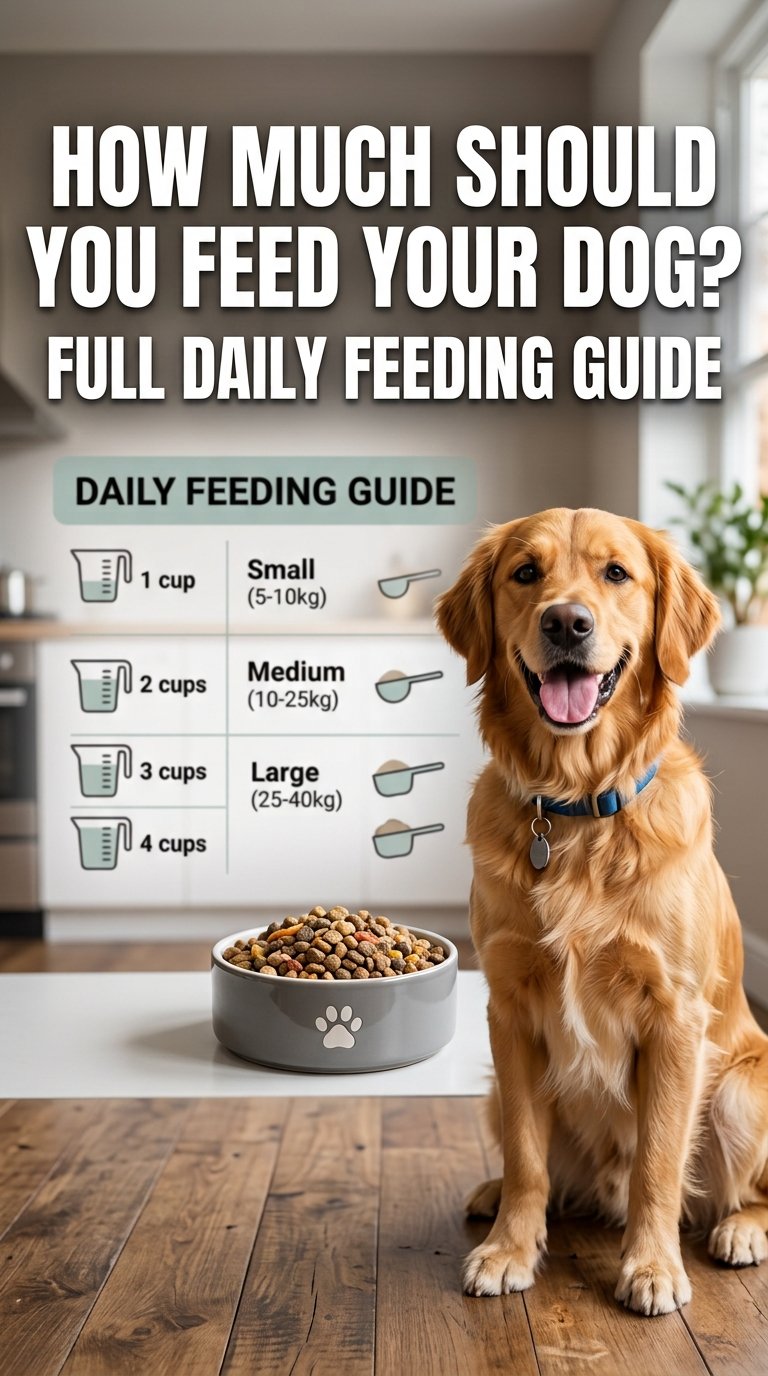
Full Dog Feeding Chart by Weight
The following chart provides a general starting point for dry dog food.
Actual portions can vary significantly because different dog foods contain different amounts of calories per cup.
| Dog Weight | General Daily Amount of Dry Food |
|---|---|
| 2–5 kg | Approximately ½ to 1 cup |
| 5–10 kg | Approximately 1 to 1¾ cups |
| 10–15 kg | Approximately 1¾ to 2½ cups |
| 15–20 kg | Approximately 2½ to 3 cups |
| 20–30 kg | Approximately 3 to 4 cups |
| 30–40 kg | Approximately 4 to 5 cups |
| 40–50 kg | Approximately 5 to 6 cups |
| 50+ kg | Approximately 6+ cups depending on activity and food calories |
Important: This chart is only a general estimate. Always check the calorie content and feeding instructions for the specific food you use.
A cup of one dog food brand may contain significantly more calories than a cup of another.
Why Dog Food Calories Matter More Than Cups
One of the biggest lessons I learned when comparing dog foods is that one cup is not always one nutritional portion.
Imagine two bags of dry food.
Food A
400 calories per cup.
Food B
550 calories per cup.
If you give your dog two cups of each food, the total calorie intake is very different.
Two Cups of Food A
800 calories.
Two Cups of Food B
1,100 calories.
That is a major difference.
This is why simply saying:
“My dog eats two cups every day”
does not tell you whether the portion is appropriate.
Check the food label for calorie information and feeding recommendations.
How to Calculate Your Dog’s Daily Food Portion
You can use a simple step-by-step method.
Step 1: Check Your Dog’s Current Weight
Use a reliable scale.
For small dogs, you may be able to weigh yourself first and then weigh yourself while holding your dog.
For larger dogs, you may need:
- A veterinary scale
- A pet scale
- A professional grooming facility with a suitable scale
Record the weight.
Do not rely only on visual guesses.
Step 2: Check the Dog Food Label
Look for:
- Recommended daily feeding amount
- Calories per cup or serving
- Life stage recommendations
The package should tell you how much food is generally recommended for dogs of different weights.
Use this as your starting point.
Step 3: Consider Your Dog’s Activity Level
Ask yourself honestly:
Is your dog highly active?
Or does your dog spend most of the day resting?
Highly Active Dogs May Include:
- Working dogs
- Dogs that run regularly
- Sporting dogs
- Dogs with long daily exercise sessions
Less Active Dogs May Include:
- Dogs with limited exercise
- Older dogs
- Dogs that spend most of the day indoors
More activity can mean higher calorie requirements.
Less activity can mean lower calorie requirements.
Step 4: Divide the Daily Food Into Meals
Most adult dogs do well with their daily food divided into multiple meals.
A common routine is:
Morning
Half of the daily portion.
Evening
The other half.
For example, if your dog needs two cups per day, you might provide:
- 1 cup in the morning
- 1 cup in the evening
However, individual needs can vary.
Puppy Feeding Chart
Puppies are different from adult dogs.
They are growing and may need more frequent meals.
A general schedule may look like this:
| Puppy Age | General Meal Frequency |
|---|---|
| 8–12 weeks | 3–4 meals daily |
| 3–6 months | 3 meals daily |
| 6–12 months | Usually 2 meals daily |
| Adult stage | Usually 1–2 meals daily |
The exact amount depends heavily on:
- Breed
- Expected adult size
- Growth rate
- Food type
- Calories
Large-breed puppies may have different nutritional requirements from small-breed puppies.
Always choose food appropriate for your puppy’s life stage and expected size.
How Much Should You Feed a Small Dog?
Small dogs often eat smaller portions, but they can have relatively high energy needs compared with their body size.
A small dog may need food specifically formulated for small breeds because:
- Kibble size may be easier to eat
- Calorie density may differ
- Nutritional formulas can vary
For example, a small 5-kilogram dog will obviously need a much smaller portion than a 30-kilogram dog.
However, do not reduce the portion based only on cup size.
Check your dog’s calorie needs and the food label.
How Much Should You Feed a Large Dog?
Large dogs consume larger quantities of food, but bigger portions do not automatically mean you should leave food available all day.
Free-feeding can make it difficult to monitor exactly how much your dog eats.
Measuring meals has several benefits:
- Easier weight monitoring
- Better portion control
- Easier detection of appetite changes
- More predictable routines
For large breeds, maintaining a healthy body condition can be particularly important because excess weight can place additional stress on joints and mobility.
How Often Should You Feed an Adult Dog?
Many adult dogs are fed twice daily.
For example:
Morning Meal
7:00–9:00 AM
Evening Meal
5:00–7:00 PM
The exact schedule matters less than consistency.
Try to feed your dog around similar times each day.
A regular routine can also help you notice changes in appetite.
If a normally food-motivated dog suddenly refuses meals, that may be worth discussing with a veterinarian, especially if other symptoms are present.
Should You Feed Your Dog Once or Twice a Day?
For many dogs, dividing food into two meals can make portion management easier.
Instead of one large meal, the daily portion is split into smaller meals.
For example:
Daily Amount
3 cups.
Morning
1.5 cups.
Evening
1.5 cups.
Your dog’s individual routine may be different.
Factors such as age, health, and veterinary recommendations can affect meal frequency.
How Do You Know If You Are Feeding Too Much?
One of the most common mistakes is gradually increasing portions because the dog appears hungry.
Many dogs will happily eat more food even when they do not need additional calories.
Watch for signs such as:
- Gradual weight gain
- Reduced visible waist
- Difficulty feeling the ribs
- Lower energy levels
- Reduced mobility
Do not make extreme changes suddenly.
If your dog is gaining weight, review:
- Food portions
- Treats
- Table scraps
- Exercise levels
A veterinarian can help determine whether your dog is overweight and recommend an appropriate plan.
How Do You Know If You Are Feeding Too Little?
Possible signs that a dog may not be receiving enough nutrition can include:
- Unexpected weight loss
- Visible ribs or bones
- Low energy
- Poor body condition
- Changes in coat quality
However, these signs can also be associated with health problems.
Do not automatically assume that increasing food is the solution.
Unexpected weight loss should be discussed with a veterinarian.
The Hidden Calories in Dog Treats
Treats can quietly increase your dog’s daily calorie intake.
This is especially common when multiple people in the household feed the dog.
One person gives treats in the morning.
Another person gives snacks in the afternoon.
Someone else shares food during dinner.
By the end of the day, the dog may have eaten far more calories than expected.
I recommend keeping track of treats.
You can use:
- A notes app on your phone
- Google Sheets
- A shared family checklist
- A pet-care app
This is especially helpful if several people care for the same dog.
Should You Measure Dog Food With a Cup?
Yes, but be consistent.
A measuring cup can help prevent accidental overfeeding.
For better accuracy, a digital kitchen scale can be even more useful.
Different foods can have different weights per cup.
Using a scale allows you to measure portions more consistently.
Useful tools include:
- Measuring cups
- Digital kitchen scales
- Airtight food containers
- Feeding schedules
- Smartphone reminders
Wet Food vs Dry Food: Does the Amount Change?
Yes.
Wet and dry food have different moisture levels and calorie densities.
You cannot always replace one cup of dry food with one cup of wet food.
If you combine wet and dry food, calculate the total daily calories carefully.
For example:
Morning
Wet food.
Evening
Dry food.
Make sure the combined meals do not significantly exceed your dog’s daily calorie needs.
The food packaging can help you determine calorie content.
Feeding Chart Based on Activity Level
The general feeding amount may need adjustment based on activity.
| Activity Level | General Feeding Consideration |
|---|---|
| Low activity | May need fewer calories |
| Moderate activity | Follow standard feeding guidelines |
| High activity | May require additional calories |
| Working or sporting dog | May require significantly different feeding plans |
These are not exact prescriptions.
Activity is only one factor.
Body condition and veterinary guidance are equally important.
Senior Dog Feeding
Older dogs do not always need dramatically less food.
Some senior dogs remain active and healthy.
Others become less active and may gain weight more easily.
When feeding a senior dog, monitor:
- Body weight
- Muscle condition
- Activity level
- Appetite
- Digestive changes
Senior dogs with health conditions may need specialized diets.
Always discuss major diet changes with a veterinarian.
Feeding Dogs With Special Health Needs
Dogs with certain health conditions may require specific nutritional management.
Examples can include:
- Diabetes
- Kidney disease
- Food allergies
- Digestive disorders
- Obesity
Do not rely on a general online feeding chart for a dog with a serious medical condition.
Your veterinarian may recommend:
- A specific food
- Specific calorie intake
- Scheduled feeding times
- Controlled treats
Individual medical needs should always take priority over a general chart.
Common Dog Feeding Mistakes
1. Feeding Based Only on What the Dog Wants
Many dogs will eat whenever food is available.
Appetite alone is not always a reliable guide to calorie requirements.
2. Never Measuring Food
Guessing portions can gradually lead to overfeeding.
Use a measuring cup or scale.
3. Forgetting Treat Calories
Treats count as part of your dog’s overall daily calorie intake.
4. Ignoring Weight Changes
Check your dog’s weight regularly.
Small changes over several months can become significant.
5. Changing Food Too Quickly
Sudden diet changes can cause digestive problems for some dogs.
When changing foods, consider a gradual transition and follow veterinary advice when necessary.
6. Using One Feeding Chart Forever
Your dog’s needs can change.
A puppy grows.
An adult dog may become more or less active.
A senior dog may have different nutritional needs.
Review portions regularly.
A Simple Daily Dog Feeding Routine
Here is a practical example for an adult dog.
Morning
- Measure half the daily food portion
- Provide fresh water
- Observe appetite
During the Day
- Keep track of treats
- Encourage appropriate exercise
- Monitor water intake
Evening
- Provide the remaining food portion
- Avoid accidentally doubling meals
- Check for unusual appetite changes
Weekly
- Observe body condition
- Check activity levels
- Review treat intake
Monthly
- Weigh your dog if possible
- Adjust food portions carefully if needed
A Practical Example
Imagine your dog’s food label recommends:
2½ cups per day for your dog’s weight and activity level.
You could start with:
- 1¼ cups in the morning
- 1¼ cups in the evening
After several weeks, observe your dog’s body condition.
If your dog is gaining excessive weight despite normal activity, you may need to review the portion and total calorie intake.
If your dog is losing weight unexpectedly, do not simply increase food without considering whether illness could be involved.
The goal is to maintain a healthy body condition rather than blindly following a number on a chart.
Final Thoughts
The best answer to “How much should I feed my dog?” is not a single number.
A feeding chart is a useful starting point, but your dog’s individual needs matter more.
Start by checking your dog’s weight and the feeding instructions on the specific food you use. Consider age, activity level, treats, body condition, and health status. Measure portions instead of guessing, and monitor your dog’s weight regularly.
If you notice unexplained weight loss, rapid weight gain, major appetite changes, vomiting, diarrhea, or other concerning symptoms, contact a qualified veterinarian.
Feeding your dog the right amount is less about finding a perfect number and more about paying attention over time. A measured portion, regular monitoring, and small adjustments can help you create a feeding routine that fits your dog’s real needs.