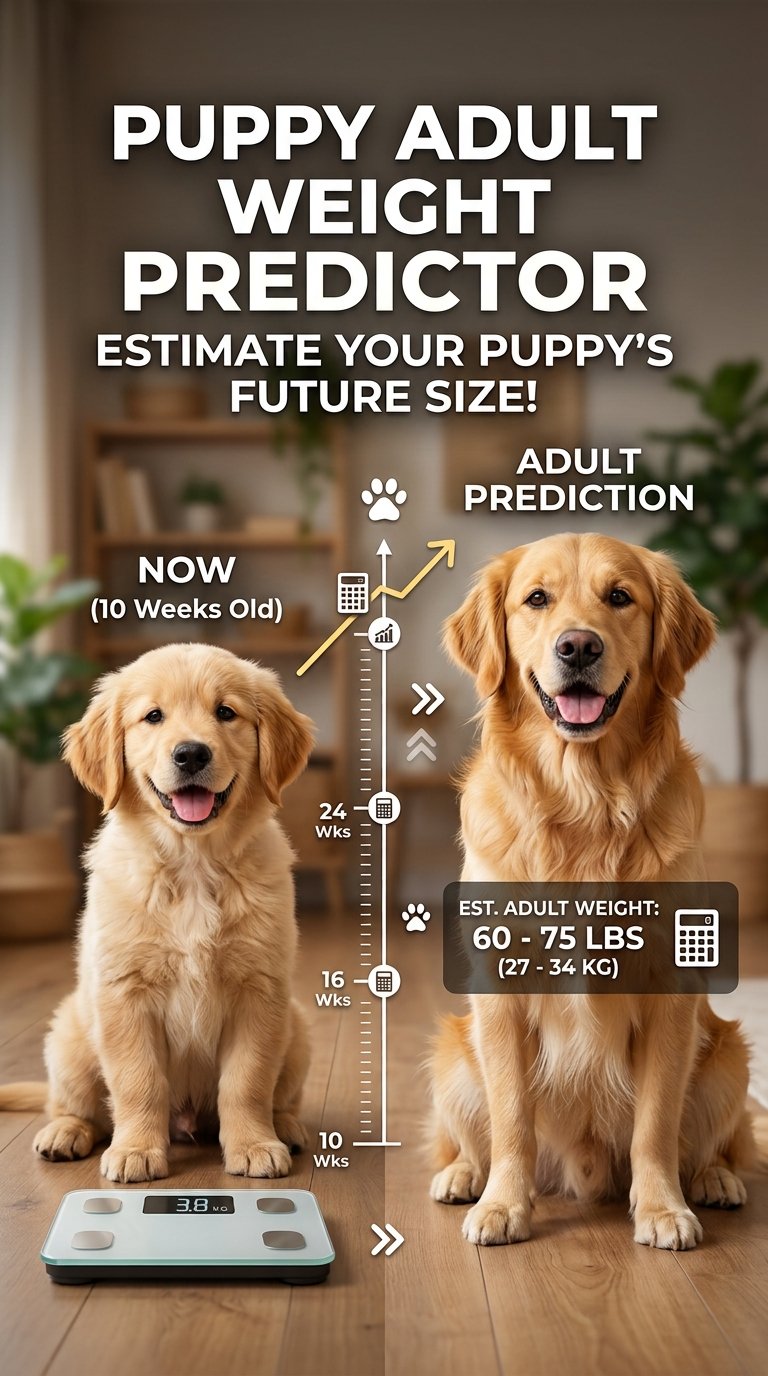

🐶 Puppy Adult Weight Predictor
One of the most common questions new puppy owners ask is:
How big will my puppy become?
If you brought home a young puppy, especially a mixed breed, predicting adult size can feel almost impossible.
Those tiny paws may look enormous. Your puppy might gain weight quickly for a few weeks and then suddenly slow down. Two puppies from the same litter may even grow at slightly different rates.
Our Puppy Adult Weight Predictor Calculator helps you estimate your puppy's possible adult weight using information such as their current weight and age, particularly during the early 8-to-12-week period.
The result can give you a useful estimate of your puppy's future size.
However, it is important to understand that no calculator can predict an individual puppy's final adult weight with complete accuracy.
Genetics, breed, sex, nutrition, health, and growth patterns can all affect the final result.
Think of the calculator as a helpful planning tool rather than a guarantee.
How Does the Puppy Adult Weight Predictor Calculator Work?
The calculator uses your puppy's current information to estimate possible adult weight.
The main inputs usually include:
- Current puppy weight
- Current age
- Breed size or expected size category
For younger puppies, growth patterns can sometimes be used to estimate a possible adult range.
The result may be more useful when compared with information about the puppy's parents or breed.
Why Are 8 to 12 Weeks Important for Weight Prediction?
The early puppy stage is a period of rapid growth.
Between approximately eight and twelve weeks, many puppies are developing quickly.
Their current weight can provide useful information about their general growth pattern.
However, growth does not happen at the exact same rate for every puppy.
Some puppies grow rapidly early and slow down later.
Others may grow more gradually.
Large and giant breeds may continue growing for much longer than small breeds.
This is why an estimated adult weight should be presented as a range whenever possible.
How to Use the Puppy Adult Weight Predictor Calculator
Using the calculator is simple.
Step 1: Weigh Your Puppy
Use the most accurate weight possible.
For small puppies, a digital pet scale or sensitive household scale may be useful.
For larger puppies, you can use:
- A veterinary scale
- A pet scale
- A household scale where appropriate
Try to weigh your puppy under similar conditions each time.
Step 2: Enter Your Puppy's Age
Enter your puppy's age in weeks.
The calculator is particularly useful when your puppy is within the age range supported by the tool, such as:
- 8 weeks
- 9 weeks
- 10 weeks
- 11 weeks
- 12 weeks
Accurate age information is important because weight means different things at different stages of growth.
Step 3: Enter Your Puppy's Current Weight
Enter the current weight in:
- Kilograms
- Pounds
Make sure the unit is correct before calculating.
Entering pounds instead of kilograms could produce a completely unrealistic result.
Step 4: Generate the Estimated Adult Weight
The calculator uses the available information to estimate a possible adult weight.
The result may show:
- Estimated adult weight
- Possible weight range
- General size category
For example:
Estimated adult weight: approximately 20–25 kg
This does not mean your puppy will definitely reach that exact weight.
It provides a general estimate based on early growth information.
Why Puppy Adult Weight Predictions Are Not Exact
Predicting adult size is difficult because puppies do not all grow the same way.
Several factors influence growth.
Genetics
Genetics are one of the biggest factors.
If you know the size of both parents, this information can provide useful context.
A puppy from two medium-sized parents is generally more likely to become medium-sized than giant-sized.
However, genetics can still produce variation.
Breed
Different breeds have different growth patterns.
A small breed may reach adult size relatively quickly.
A giant breed may continue developing for much longer.
Sex
Male and female dogs of the same breed can sometimes differ in adult size.
This is another reason a calculator should provide an estimate rather than an exact prediction.
Nutrition
A balanced diet supports normal growth.
Overfeeding does not necessarily produce healthier development.
Rapid growth is not always desirable, especially for certain large-breed puppies.
Health
Health problems, digestive issues, parasites, or other conditions can affect growth.
If a puppy is not gaining weight as expected, contact a veterinarian.
Small, Medium, and Large Breed Growth Patterns
Small Breeds
Small dogs often reach physical maturity earlier.
Examples may include:
- Chihuahua
- Pomeranian
- Yorkshire Terrier
- Maltese
Medium Breeds
Medium-sized dogs may have a more moderate growth period.
Examples include:
- Beagle
- Border Collie
- Cocker Spaniel
Large Breeds
Large breeds may continue growing for a longer period.
Examples include:
- German Shepherd
- Labrador Retriever
- Golden Retriever
Giant Breeds
Giant breeds can continue developing for an extended period.
Examples may include:
- Great Dane
- Mastiff
- Saint Bernard
Early weight prediction may be less precise for puppies with very large expected adult sizes.
How to Get a More Accurate Adult Weight Estimate
The calculator can provide a starting point.
You can improve your understanding by considering additional information.
Know the Parent Sizes
If possible, find out the adult weight of:
- Mother
- Father
This may provide useful genetic context.
Track Growth Regularly
Instead of relying on one weight measurement, track your puppy over several weeks.
Use:
- A digital scale
- A notebook
- Google Sheets
- Microsoft Excel
Regular measurements can show the overall growth trend.
Consider the Breed
If your puppy is a known purebred, breed growth information may provide additional context.
Mixed breeds may have wider variation.
How to Create a Puppy Growth Record
A simple growth record can help you understand how your puppy is developing.
Example:
| Age | Weight | Change | Notes |
|---|---|---|---|
| 8 weeks | 3 kg | Starting weight | Active |
| 10 weeks | 4 kg | +1 kg | Appetite normal |
| 12 weeks | 5.2 kg | +1.2 kg | Growing steadily |
The numbers themselves are less important than the overall pattern.
Unexpected changes may be worth discussing with a veterinarian.
Common Mistakes When Predicting Puppy Adult Weight
Assuming the Calculator Is Always Exact
The result is an estimate.
Using an Incorrect Age
A one-week difference can matter when using rapid early growth calculations.
Entering the Wrong Unit
Always check whether you are using kilograms or pounds.
Ignoring Genetics
Parent size can provide valuable context.
Comparing Your Puppy to an Unrelated Puppy
Different breeds grow differently.
What If Your Puppy Is a Mixed Breed?
Mixed-breed puppies can be harder to predict.
If the parent breeds are known, enter the information available and consider the expected size of the parents.
If the breed background is unknown, the calculator can still provide a general estimate based on early growth.
However, the possible range may be wider.
Regular growth tracking can provide more useful information over time.
Frequently Asked Questions
How accurate is a puppy adult weight calculator?
It provides an estimate based on growth information. Genetics and other factors mean that the final adult weight may differ.
Can I predict my puppy's size at eight weeks?
You can make a general estimate, but accuracy varies depending on breed and available information.
Is a 12-week prediction more accurate?
Additional growth information may sometimes improve an estimate, but no prediction is guaranteed.
Do big paws mean my puppy will become a big dog?
Large paws can be interesting to observe, but paw size alone is not a reliable method for predicting final adult weight.
When do puppies stop growing?
This depends heavily on breed size. Small breeds often mature earlier, while large and giant breeds may continue growing and developing for much longer.
Important Disclaimer
This Puppy Adult Weight Predictor Calculator provides an estimated adult weight for informational purposes only.
It cannot guarantee your puppy's final size or diagnose growth-related health concerns.
Puppy growth is influenced by genetics, breed, sex, nutrition, health, and individual development.
If your puppy is experiencing poor growth, unexpected weight loss, digestive problems, or other health concerns, contact a qualified veterinarian.
Final Thoughts
A puppy's adult size can be difficult to predict, especially when they are only eight to twelve weeks old.
A Puppy Adult Weight Predictor Calculator provides a useful starting estimate using your puppy's current age and weight.
The best approach is to use the result as a guide and continue tracking your puppy's growth over time.
Knowing the size of the parents, understanding the breed, and maintaining regular weight records can provide additional context.
Most importantly, focus on healthy growth rather than trying to make your puppy reach a predicted number.
Your puppy's individual health and development matter more than whether the final adult weight matches a calculator estimate exactly.